
Control by (or chosen "servitude" to) the powerful (~1,540 words, ~10 minutes)
How do we reduce our vulnerabilities to the scams of the powerful?

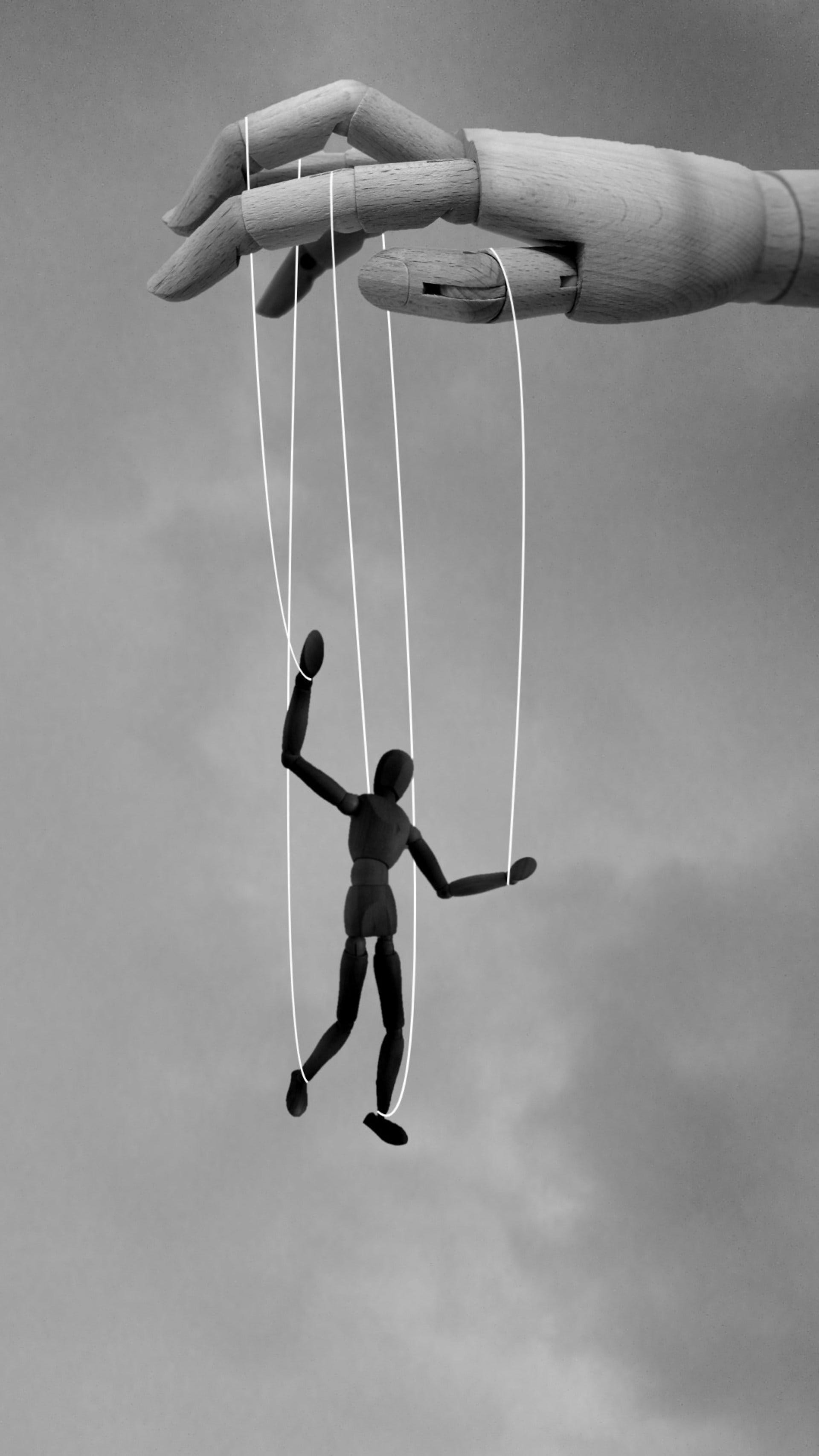
Photo by Sivani Bandaru on Unsplash (a puppet is being controlled by the hand of its master)
The outstanding independent journalist and author Alisa Valdes-Rodriguez is publishing a series on revolutions on her Substack channel (“The Pugilist”), and, as I write this, the most recent episode is on “”Haiti, 1791: The Revolution that freed itself”

This articles provides a series of insights that, in my opinion, are unparalleled and should be noted - for example:
“The arithmetic of the plantation had concluded it was cheaper to work a person to death and buy another than to let that person live.”
and
“This is the maneuver to watch for in every age. When domination can no longer be held with the whip, it gets refinanced as debt. The ledger is patient. It does not need to own you outright if it can keep you forever in arrears.
When people like Donald Trump remark upon the poverty of Haiti, what they fail to mention is that it is men like Donald Trump who have forced Haiti to be poor, as punishment for refusing to be dominated in any other way.”
The Haitian revolution was different to most, as it was led by
“[t]he people forced to exist at the very bottom of the economic and social hierarchy — the enslaved, the conquered, those counted as property or not counted at all … It was made by the people who held nothing, who were counted as property, who were not supposed to be capable of making history at all. They did not merely win their freedom; they built a nation out of it — the first sovereign state in the world founded by the formerly enslaved, and the living nightmare of every slaveholding power on earth. They made the impossible look like a matter of will. And for the crime of winning that completely, the world handed them a bill that took 122 years to pay.”
(For more on these events from other sources, see The Collector, Britannica, Wikipedia; “The Counter-Revolution of 1776 Slave Resistance and the Origins of the United States of America”, by Gerald Horne (pub. New Your University Press, New York and London, 2014, ISBN 978-1-4798-0872-4 (ebook)); and, from more recent times, “The Big Truck That Went By”, by Jonathan M. Katz, (first published in 2013 by Palgrave Macmillan® a division of St. Martin’s Press LLC - now Springer Nature Link, ISBN 978-0-230-34187-6).)
I have always considered that debt (a “finance trap”) imposed to compensate the slaveholding capitalists was utterly unconscionable, and would have been more than offset by the reparations owed for the human rights atrocities of slavery.
The author has also provided a wider, current perspective on the issue of finance traps, which I have added my broadening of perspective to - see below.
So … in addition to finance traps (which are part of consumerism - i.e., having lots of stuff, and the latest version or replacements because of planned obsolescence), time (and energy or health) traps are an issue.
This became very obvious to me in the 1980s, when I worked for a manager who I consider likely had all three of the Dark Triad of psychology - psychopathy [Note 1], Machiavellian, and narcissism. All the other nasty people in the workplace (and there were a lot) were just humans being nasty.
That particular boss went out of his way to make sure his staff were overloaded and far too busy to lodge complaints about the many abuses which occurred - and those who tried as often as not wound up out of a job.
As someone starting out in my career, in an era when everyone was expected to be self-sacrificing (and to put work before everything else) and to work without any positive feedback (only criticism), trying pointlessly to change things for the better wasn’t a good long term strategy. (Although I did try a few times - with mixed results.)
I have written elsewhere about those experiences, but for now, what I want to consider is why that psychopath committed those abuses.
He never became particularly rich (although was well off in a middle class sense) or powerful, he lost his marriage, no-one else would hire him (or if they did, he was soon enough out), he never got to pursue any of his personal interests, so … why?
Did he take a perverse pride in what he considered a form of service to something greater than himself (which would have to be described as company profit)?
Did he get pleasure out of obeying programming (social conditioning or parenting) that told him society should be a cold, hard and judgmental place?
Was he afraid of what else he could have been? Was he afraid of not being part of the abusive architecture of society?
Was he a sadist? Probably not, IMO, given the size of his ego.
Did he think he was naturally entitled to a superior position as part of being what he considered a superior person?
Maybe.
Did he have a perverse pride in a job which meant he was invisible to society?
That is something I have seen in some (generally Spiritualist) mediums, who, in effect, take great pride in suppressing their personality until they are invisible and can allow a spirit to channel through their body. (For the record, I consider such roles should be a joint partnership.)
I suspect the internal forces that controlled and compelled him to become what he was were a little of all of these.
They can be hard to understand or even notice or acknowledge - particularly when looking for the influence of the rich and/or powerful and elite, as is well described in “How I Saw the Grift Behind The Telepathy Tapes” https://esotericho.substack.com/p/how-i-saw-the-grift-behind-the-telepathy “A Story On Media Literacy and High-Control Systems” by EsotericHoe (“Deconstructing Our Conditioning. Reclaiming Our Sovereignty”):
“… here’s what makes this particularly insidious: high-control groups rarely invent entirely new lies. They co-opt existing truths and deploy them to bypass your critical thinking. Whoever defines the “truth” holds the power. In the case of The Telepathy Tapes, even if telepathy is real, the methodology utilized by the project effectively grants “Facilitators” monopoly power over the children’s voices. While proponents cite instances of independent spelling as a defense, the systemic reliance on facilitated interaction creates a dynamic where leadership defines what the children say, how they say it, and who gets to hear it. Even in a telepathic world, power dynamics still exist. And when I stepped into my role as a moderator, I didn’t see a community pursuing spiritual growth—I saw a community being sold a standardized spiritual product. (Check out the work being done by Heidi Rachel Brown on TikTok).
This matters to me personally because I honor the possibility of telepathy.”
The author then analyses the techniques used for control (and an example of how they attempted to protect themselves) - it is an excellent, and important article: please read that, and the article I linked to above. This, IMO, helps to extend what Alisa Valdes-Rodriguez wrote to groups at below national level.
From the point of view of this article of mine, these provide more specific options of analysis than the Dark Triad (and authoritarianism) character traits, but it is important, if we are to make this world a better place, that we determine why people join up to support the elites - which has a lot disparaging terms, but the one I will give it is:
traitor to humanity and decency
Those people are the enablers that make the ultra-elites domination possible - they are the foot soldiers of evil.
They have basically been vulnerable to a particularly egregious scam - which means they are vulnerable to a future, similar scam.
And that means that, for the sake of a world that is stably better, their flaws must be addressed.
This quote from Simone de Beauvoir in “The Ethics of Ambiguity” also applies, IMO:
“The oppressor would not be so strong if he did not have accomplices among the oppressed”.
The work of people like Tad Stoermer and Alisa Valdes-Rodriguez addresses the broader social scale of what needs to be done to make inhuman societies and the world into better places … I am saying don’t forget the personal flaws along the way.
I’ve advocated for some approaches to do so (teaching using critical thinking [including addressing the emotional flaws that limit use of that skill], identifying and analysing and resisting rhetoric, and emotional competence - in particular, identifying and analysing and resisting emotional manipulation), but examining the sort work in the two examples I have linked to opens up new fields of opportunity for change for the better … which I will leave to those who are better and less exhausted than I.
In the course of preparing this article, I came across the following two resources on psychopathy which seem to me to be quite good:
Koehn, M. A., Okan, C., & Jonason, P. K. (2019). A primer on the Dark Triad traits. Australian Journal of Psychology, 71(1), 7–15. https://doi.org/10.1111/ajpy.12198
“The 4 Building Blocks of the Dark Triad” (2025) https://www.psychologytoday.com/us/blog/fulfillment-at-any-age/202506/the-4-building-blocks-of-the-dark-triad “New research identifies 4 conditions favorable for growth of the dark triad” Key points: “(1)The dark triad, or D, is often regarded as reflecting immutable qualities that are inborn into personality. (2) A new study examines trends across two decades, drawing links between harsh environments and D. (3) By viewing personality as flexible, there’s hope we can build more favorable sets of qualities in all.” “The authors translated socioecological influences into the following four factors: 1. Corruption (tolerance of gaining personal benefits at the cost of others) 2. Economic inequality (unequal distribution of wealth) 3. Poverty (income index) 4. Extent of violence (death rates due to armed violence, homicides)”
If you wish to encourage or support me you can do so at PayPal or Ko-Fi – and such would be appreciated, and help me to keep writing here.
As a postscript, this article also deserves to fit in here:
“WHY JACK SMITH IS MY CAPTAIN AMERICA” https://substack.com/home/post/p-204788776 “A Fourth of July lesson in integrity from the one man Donald Trump couldn't scare, couldn't buy, and couldn't shut up.”